Guide
NYC Property Records: How to Search ACRIS, Deeds and Property Data Free (2026)
How to search NYC property records for free: find the owner, deed, sale price, mortgage, taxes, zoning and violations for any building, step by step.
Every building in New York City leaves a public paper trail. NYC property records are public records, available online across the five boroughs: who owns it, what they paid, who lent them the money, what they owe in taxes, what can be built on the lot and what the city has cited them for. All of it is free and official, and you can pull it yourself in about ten minutes.
This step-by-step guide shows real estate professionals, investors and curious owners where NYC property records live, how to search ACRIS and the other city databases, and how to read what you find, whether the property is in Manhattan, Brooklyn, Queens, the Bronx or Staten Island. At the end, we walk through a real Midtown office tower using nothing but city records.
Short on time?
Our Building Check is a free tool that pulls the owner, recorded sales, loans, zoning and open violations for any property in New York City in one lookup, with a link to every source record. This guide shows you where those records come from and how to read them.
Where NYC property records live
NYC property records aren’t in one database. They’re spread across six official data sources run by city agencies and the Richmond County Clerk’s Office. None of them requires a paid account, and most don’t even ask for a free account. The City of New York maintains them as free property records for anyone to use. The trick is knowing which system answers which question, and the one number that connects them all.
Here is the short version:
| Your question | Where to look | Run by |
|---|---|---|
| Who owns it, and what did they pay? | ACRIS | Department of Finance |
| Staten Island deeds and mortgages | Land Documents Search | Richmond County Clerk |
| What are the taxes and assessed value? | Property Tax Public Access, Property Information Portal | Department of Finance |
| What’s the zoning, lot size and building size? | ZoLa, PLUTO | Department of City Planning |
| Any permits, violations or complaints? | BIS, DOB NOW Public Portal | Department of Buildings |
| Housing violations and the registered owner? | HPD Online | Housing Preservation and Development |
Step 1: Find the BBL
The BBL is a 10-digit number that identifies every tax lot in the city. One digit for the borough, five for the block, four for the lot. Most city systems let you search by address, but the BBL removes all doubt about which property you’re looking at.
Borough codes are simple: 1 is Manhattan, 2 the Bronx, 3 Brooklyn, 4 Queens and 5 Staten Island. So BBL 1012990027 means Manhattan, block 1299, lot 27.
The fastest way to get it is ZoLa, the Department of City Planning’s zoning map. Type the address, click the lot, and the BBL appears with the zoning, lot area and building details. The Department of Finance’s Property Information Portal shows the same lot on the official tax map. Once you know the BBL, every other search in this guide gets faster and more precise.
Condos have more than one BBL
Each condo unit gets its own lot number, and the building’s common areas sit on a separate “billing” lot. If a search returns dozens of lots at one address, you’re looking at a condo.
Step 2: Use ACRIS to look up the deed, owner and sale price
ACRIS (the Automated City Register Information System) is where deeds, mortgages and other recorded documents live. Think of it as the city’s database of real property transactions: each sale, loan or lien filing becomes a numbered document anyone can look up. The New York City Department of Finance (DOF) runs it through the City Register’s Office, part of its Division of Land Records. It covers Manhattan, the Bronx, Brooklyn and Queens, with document images from 1966 to the present.
What information can you find on ACRIS?
- Deeds, which record ownership transfers between a buyer or seller, with the stated sale price.
- Mortgages and the mortgage information that follows them: assignments, agreements, satisfactions.
- Liens and other filings recorded against the property.
- UCC filings (Uniform Commercial Code) tied to real property, such as fixture filings.
- Real property transfer tax returns filed with each sale.
How to use ACRIS
To search it:
- Go to nyc.gov/acris and choose Search Property Records.
- Pick Parcel Identifier (BBL) and enter the borough, block and lot. You can also search by property address, by party name (an owner or lender) or by document type.
- Sort the results by document type. DEED shows sales; MTGE (mortgage), AGMT (agreement), SAT (satisfaction) and ASST (assignment) show the financing story.
- Click DET for the summary, or IMG to open the scanned document itself.
Use the official site
The Department of Finance states that ACRISasap and ACRIS.com are not approved Department of Finance services. The real ACRIS is free. It also limits each user to 400 MB of downloads a day and restricts robots and scripts.
Stuck? Ask the ACRIS help desk
If a search isn’t working, call or email the ACRIS help desk, run by the Department of Finance: (212) 487-6300 or acrishelp@finance.nyc.gov.
What about Staten Island?
Staten Island deeds and mortgages are not in ACRIS. They’re recorded with the Richmond County Clerk, which runs its own free Land Documents Search. The New York Public Library notes those records are digitized and online back to 1945. Even though Staten Island appears as a borough option inside ACRIS, the deed itself lives with the County Clerk.
Step 3: Read the deed, the mortgage and the chain of title
An ACRIS index line tells you a document exists. The document tells you what happened. When you open a deed, look for five things:
- Document date vs. recorded date. The document date is when it was signed; the recorded date is when the city logged it. They’re often days or weeks apart.
- Consideration. The stated sale price.
- Grantor and grantee. The seller and the buyer. In the city’s data, party 1 is the grantor and party 2 the grantee.
- Transfer tax returns. The city and state transfer tax forms filed with the deed add detail about the sale.
- Related documents recorded the same day. A sale is usually a bundle: the deed plus new or assigned mortgages, agreements and assignments of leases and rents.
Line up every deed for a property, oldest to newest, and you have its chain of title: who sold to whom, and when. That’s what a title company checks formally before a closing. For your own research, those deeds let you trace the property ownership history of most buildings back decades.
A recorded price is not the whole deal
The consideration on a deed doesn’t tell you about assumed debt, credits, fees or side agreements. Treat it as one verified fact, not the full economics.
Co-op apartments work differently
A co-op buyer purchases shares in a corporation, not real property, so a co-op sale usually doesn’t produce a deed. You’ll often find related financing filings instead, and the building itself has one owner of record: the co-op corporation.
Who’s behind LLCs?
Most NYC investment properties are bought by a single-purpose limited liability company (LLC), so the owner of record is often a name like “123 Main Street Owner LLC.” Three places can help:
- The signature page of the deed or mortgage. It often names the person who signed for the LLC.
- HPD Online. Most residential rental buildings must register with Housing Preservation and Development, and the registration lists the owner (the landlord) and a managing agent.
- The New York Department of State’s business entity database. It shows when the LLC was formed and who filed it, though New York LLC filings often don’t name the people behind it.
At Azzets, any link between an LLC and a real person or firm is labeled Reported unless a primary record confirms it.
Step 4: Check taxes and assessed value
The Department of Finance shows the property tax side of every property, from a single condo to a large commercial property. Use Property Tax Public Access to look up a property’s tax class, the property tax bill, payment history and any tax benefits. The Property Information Portal adds assessed values and exemptions, the building and land description, and a history of changes to the lot.
Two numbers matter most:
- Market value as the city estimates it for tax purposes.
- Assessed value, which drives the tax bill.
Neither is a sale price or an appraisal. The city’s property values are set for tax purposes and often differ a lot from what a building actually trades for, so never treat them as a valuation. If you need a value for a loan, an estate or a tax filing, hire a licensed appraiser.
Step 5: Check the zone, lot size and property data
City Planning’s data tells you what’s there and what could be built. ZoLa shows the zoning district, lot area and any special districts on a map, and it can overlay flood zone maps too. PLUTO, City Planning’s lot-by-lot property data, adds gross building area (the square footage), number of floors, year built, building class and more, and you can download it from NYC Open Data.
Know which square feet you're using
PLUTO reports gross building area. Marketing materials and press reports often quote rentable square feet, which can be a different number. Before you compare price per square foot between two deals, make sure both use the same kind of square feet.
Step 6: Check permits, violations and complaints
The New York City Department of Buildings (DOB) runs two public systems, and you need both.
- BIS (Building Information System) has a profile page for every property: job filings for construction work, permits issued before DOB NOW, complaints from 311 calls, inspections and many violations.
- DOB NOW Public Portal has filings made in DOB NOW, certificates of occupancy, and compliance violations.
The Department of Buildings is clear on the gaps. For most violation types, DOB NOW only shows violations issued after November 2024, and OATH/ECB violations and some DOB violations appear only in BIS. Complaints are in BIS, not DOB NOW. For a full picture, search both.
For apartment buildings, add HPD Online. It shows housing complaints and violations, the property registration, charges and litigation, block and lot information, and any vacate orders.
A real example: 2 Grand Central Tower
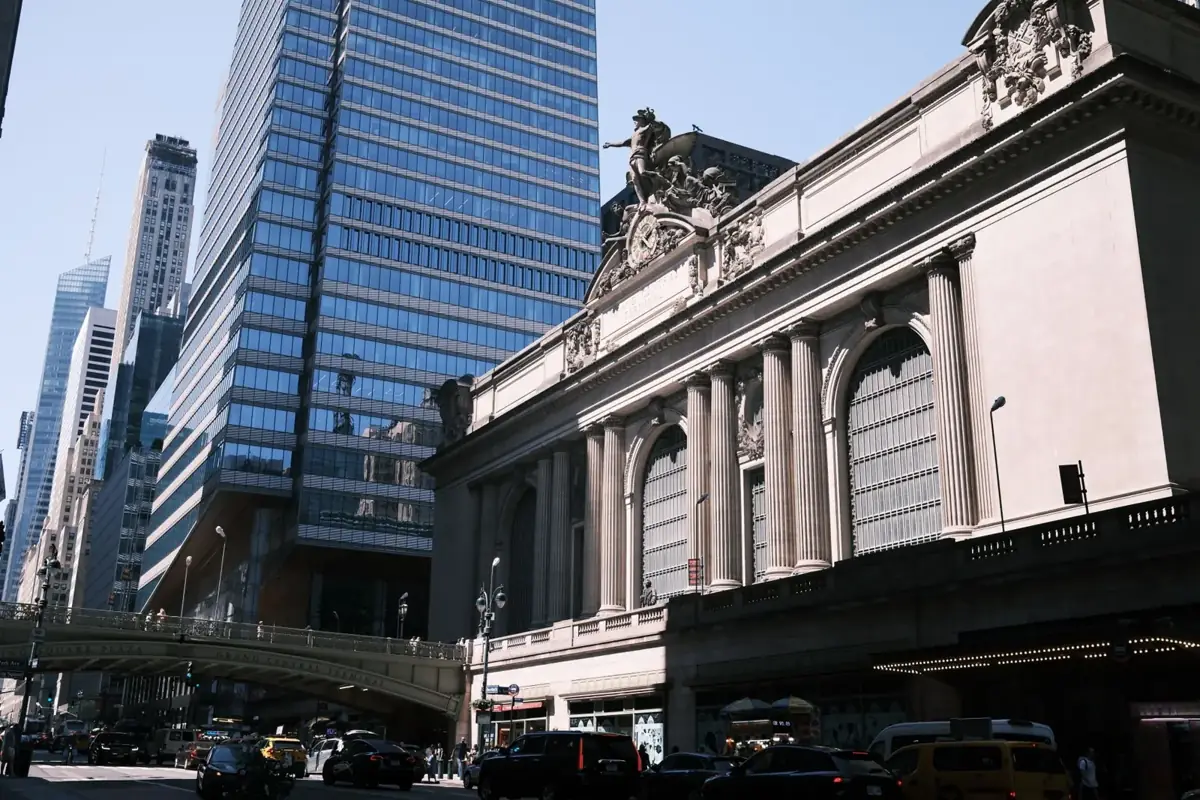
Here’s the process on a real building: the 43-story office tower known as 2 Grand Central Tower in Midtown East. City records list it at 147 East 44th Street, on BBL 1012990027. Every number below comes from ACRIS and PLUTO, pulled through NYC Open Data on November 15, 2026, and re-checked on November 19, 2026.
What PLUTO says about the building Verified
| Item | Value |
|---|---|
| Gross building area | 629,323 sq ft |
| Office area | 626,305 sq ft |
| Floors | 43 |
| Year built | 1982 |
| Lot area | 17,573 sq ft |
| Zoning district | C5-2.5 |
| Building class | O4 (office) |
What ACRIS says about its sales Verified
| Document ID | Signed | Recorded | Price |
|---|---|---|---|
| 2008081501028001 | Aug. 12, 2008 | Aug. 19, 2008 | $427,930,000 |
| 2011102700596001 | Oct. 25, 2011 | Dec. 5, 2011 | $401,000,000 |
| 2025120900893003 | Dec. 4, 2025 | Dec. 10, 2025 | $273,000,000 |
Source: ACRIS deeds 2008081501028001, 2011102700596001 and 2025120900893003 (NYC Department of Finance), via NYC Open Data, pulled Nov. 15, 2026.
What we can calculate Estimate
- Price per gross square foot in 2025: $273,000,000 ÷ 629,323 sq ft = $433.80. The same math gives $637.19 for the 2011 sale and $679.98 for 2008.
- Change since the 2011 sale: −31.9%. Since 2008: −36.2%.
- Signing to recording: 6 days for the 2025 deed, 41 days for the 2011 deed.
What the records don’t tell us. Each deed was between single-purpose LLCs, so linking them to the firms behind them takes more work. A financing-related document (an assignment of leases and rents) for $177,450,000 was recorded alongside the 2025 deed, but the record alone doesn’t show whether that’s new debt or existing debt carried over. Those questions are where real analysis begins. Our Deal File on 2 Grand Central Tower follows the loans and shows what the seller likely kept.
If you own a property: protect it
If you own property in NYC, sign up for the Notice of Recorded Document Program. The Department of Finance will email, text or mail you whenever a deed, mortgage or related document is recorded against your property. It’s free, and it’s the city’s main early warning against deed fraud. Register through the “Recorded Document Notification” link on the ACRIS site.
Going further: bulk real property transaction data
If you research many properties, a lookup one building at a time gets slow. The same records are on NYC Open Data, free to download: the ACRIS Real Property Master, Legals and Parties datasets, and PLUTO. That’s how we track every property transaction we write about and build our Deal Files, which go deeper than a single records search can. We pull the records by BBL, keep a copy with the date and the exact query, and do every calculation in tested code. You can read more in our methodology.
Want the whole process on one page? Our free NYC Building Due-Diligence Kit (PDF) turns this guide into a printable checklist, with the red flags worth a second look. It comes with the Azzets weekly email.
Common mistakes to avoid
- Searching ACRIS for a Staten Island deed. Use the Richmond County Clerk.
- Paying a look-alike site. The official systems are free.
- Mixing gross and rentable square feet when comparing price per foot.
- Treating the city’s market value as an appraisal. It’s a tax figure.
- Checking only DOB NOW or only BIS. Each holds records the other doesn’t.
- Assuming the LLC name tells you who owns the building. Often it doesn’t.
FAQ
Are NYC property records public?
Yes. Deeds, mortgages, tax records, zoning data, permits and most violations are public records, and the city publishes them for free online.
How do I find out who owns a property in NYC?
Find the BBL in ZoLa, then search ACRIS by BBL and open the most recent deed. The grantee is the buyer of record and the current owner, unless a newer document changed that. For buildings owned by an LLC, check HPD Online and the deed’s signature page for the people behind it. For Staten Island, search the Richmond County Clerk’s records instead.
How far back do ACRIS records go?
ACRIS has document images for Manhattan, the Bronx, Brooklyn and Queens from 1966 to the present. Older records are kept in the City Register’s archive on microfilm.
Is ACRIS free?
Yes. An ACRIS records search and viewing document images on the official site are free.
Who is the property owner of record?
The owner of record is the grantee on the most recent deed in ACRIS (or with the Richmond County Clerk for Staten Island).
Can I see what a building sold for?
Usually. The deed in ACRIS shows the consideration, the stated price. Keep in mind it may not include assumed debt or other terms.
This guide is educational. It isn’t legal advice and doesn’t replace a title search by a title company or attorney before a purchase.
Sources
- ACRIS: Automated City Register Information System, NYC Department of Finance · Primary · accessed November 15, 2026
- Property Information Portal, NYC Department of Finance · Primary · accessed November 15, 2026
- Property Tax Public Access, NYC Department of Finance · Primary · accessed November 15, 2026
- Recording property documents (Staten Island: Richmond County Clerk), NYC Department of Finance · Primary · accessed November 15, 2026
- Notice of Recorded Document Program: FAQ, NYC Department of Finance · Primary · accessed November 15, 2026
- Find Building Data (BIS and DOB NOW), NYC Department of Buildings · Primary · accessed November 15, 2026
- DOB NOW: Public Portal FAQs, NYC Department of Buildings · Primary · accessed November 15, 2026
- HPD Online, NYC Department of Housing Preservation and Development · Primary · accessed November 15, 2026
- ZoLa: NYC's Zoning & Land Use Map, NYC Department of City Planning · Primary · accessed November 15, 2026
- Primary Land Use Tax Lot Output (PLUTO), version 26v2, NYC Department of City Planning via NYC Open Data · Primary · accessed November 15, 2026
- ACRIS Real Property Master, Legals and Parties datasets, NYC Department of Finance via NYC Open Data · Primary · accessed November 15, 2026
- ACRIS deed, document 2025120900893003, NYC Department of Finance · Primary · accessed November 15, 2026
- ACRIS deed, document 2011102700596001, NYC Department of Finance · Primary · accessed November 15, 2026
- ACRIS deed, document 2008081501028001, NYC Department of Finance · Primary · accessed November 15, 2026
- ACRIS FAQ and help desk, NYC Department of Finance · Primary · accessed November 15, 2026
- House History: Ownership, New York Public Library · Secondary · accessed November 15, 2026
Azzets publishes education, research and commentary. Nothing on this site is investment, legal or tax advice, or an offer to buy or sell any security. Found an error? Tell us.